On the Interaction of Noise, Compression Role, and Adaptivity under $(L_0,L_1)$-Smoothness: An SDE-based Approach
PDF
arXiv
ICML
Abstract
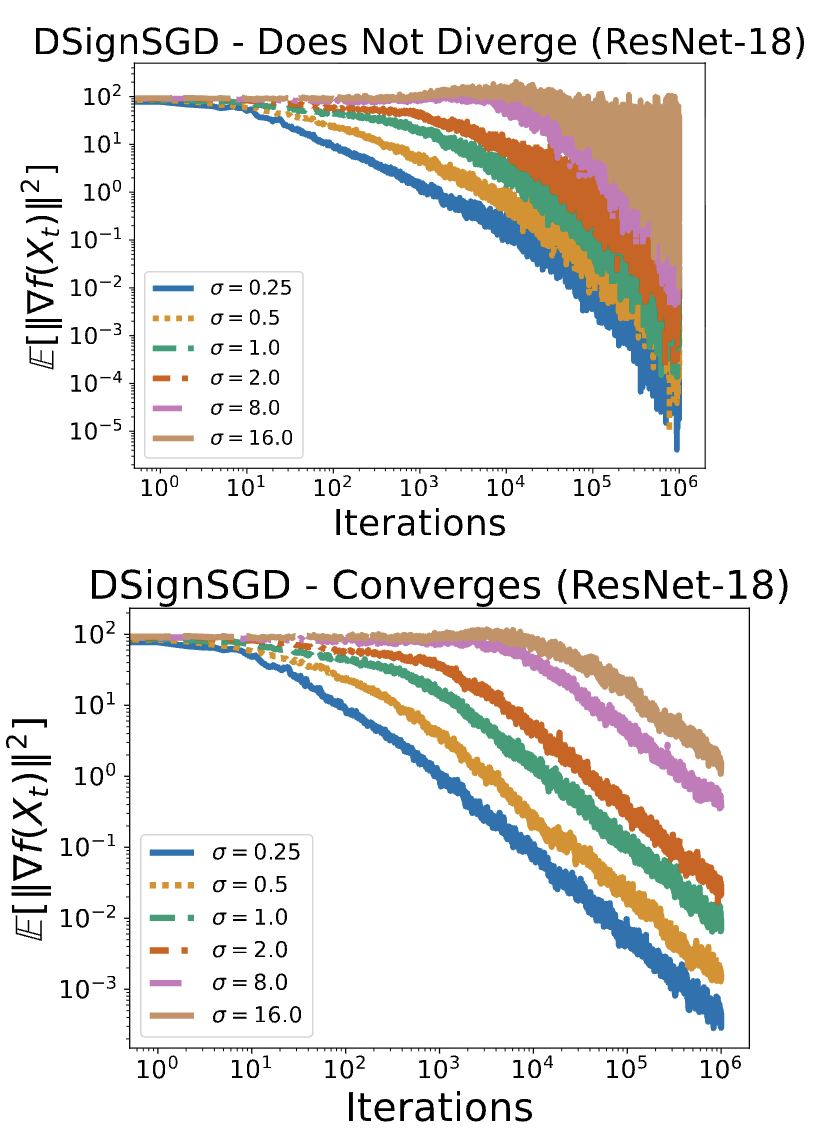
Using stochastic differential equation (SDE) approximations, we study the dynamics of Distributed SGD, Distributed Compressed SGD, and Distributed SignSGD under $(L_0,L_1)$-smoothness and flexible noise assumptions. Our analysis provides insights -- which we validate through simulation -- into the intricate interactions between batch noise, stochastic gradient compression, and adaptivity in this modern theoretical setup. For instance, we show that adaptive methods such as Distributed SignSGD can successfully converge under standard assumptions on the learning rate scheduler, even under heavy-tailed noise. On the contrary, Distributed (Compressed) SGD with pre-scheduled decaying learning rate fails to achieve convergence, unless such a schedule also accounts for an inverse dependency on the gradient norm -- de facto falling back into an adaptive method.