My Contributions
BST Scaling Rule
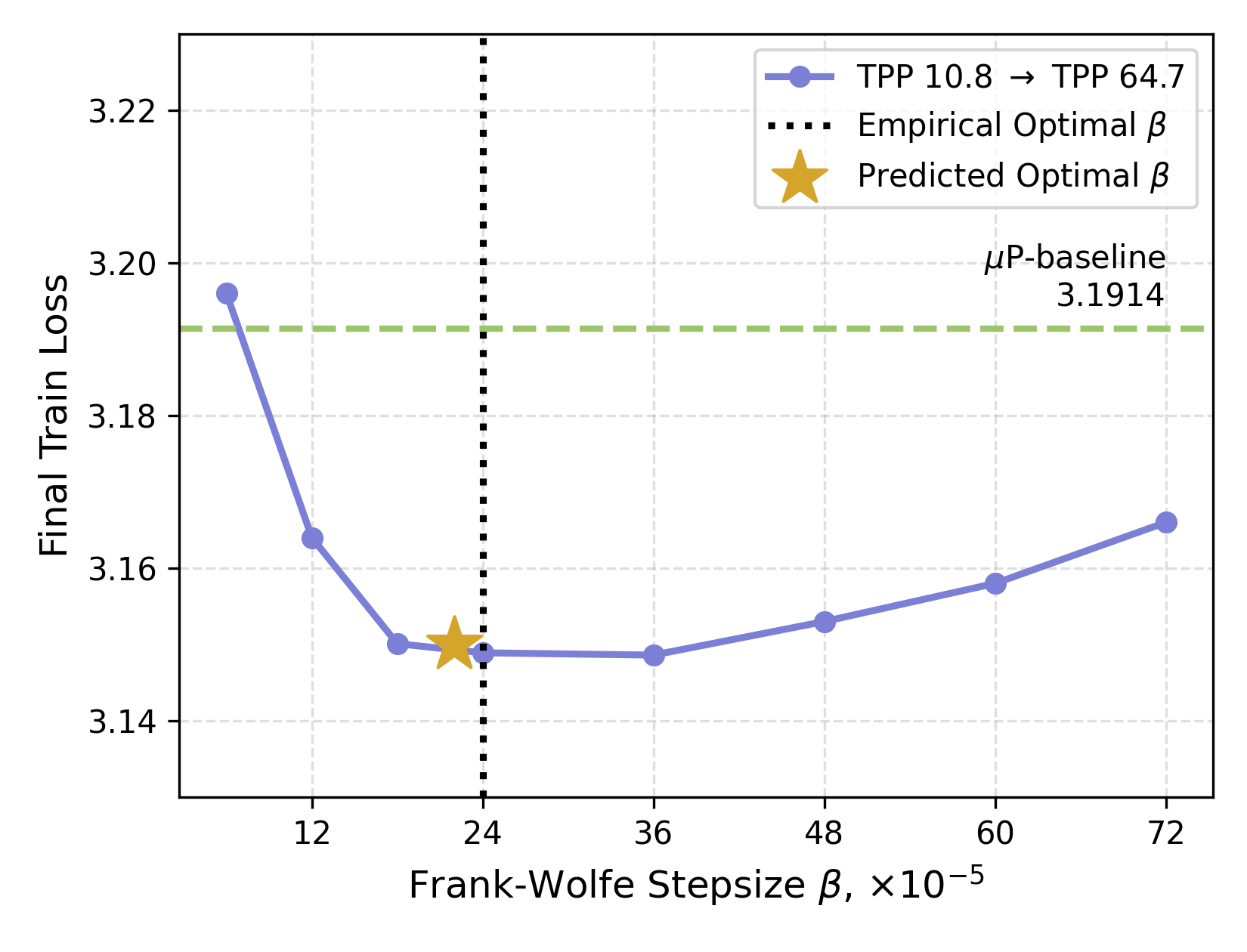
We study stochastic conditional gradient methods under a fixed token budget [21] and show that an optimal batch size exists. Our analysis yields predictive convergence rates, enabling joint token-aware scaling laws for batch size, sequence length, Frank-Wolfe stepsize, and momentum as the model size or token horizon grows.
Robustness to Learning Rate Choice
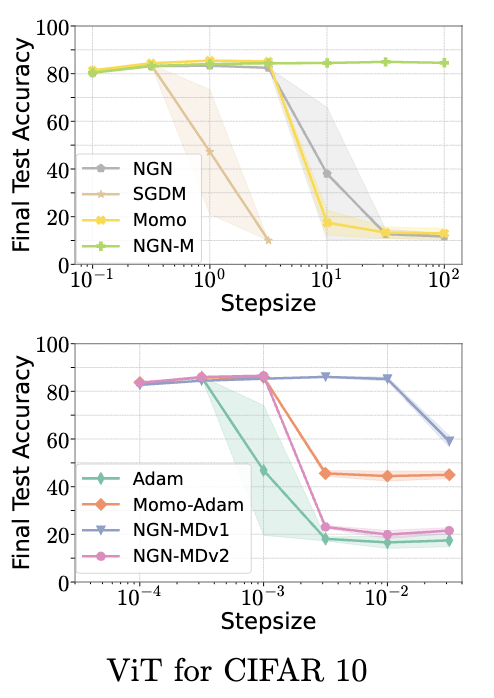
We study the coupling of the NGN stepsize with Polyak momentum [17] and show that incorporating this combination into base optimizers such as SGD and Adam improves robustness to learning-rate choice. In some cases, increasing the learning rate by up to an order of magnitude beyond its optimal value leads to little or no performance degradation, while preserving peak performance.
SDE Analysis of Adam-like Optimizers
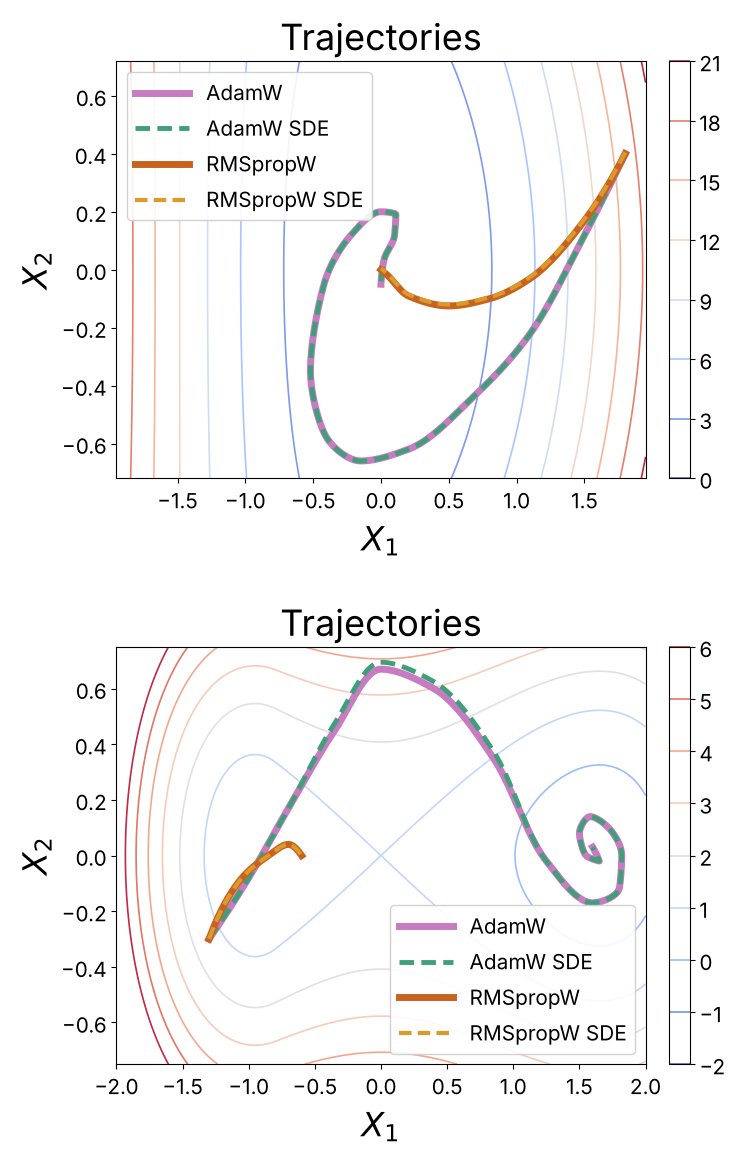
We study optimization methods such as SGD, SignSGD, and Adam through the lens of stochastic differential equations (SDEs) [12]. These SDEs provide quantitatively accurate models of the algorithms and reveal a nuanced relationship between adaptivity, gradient noise, and curvature. Our analysis of SignSGD highlights a precise contrast with SGD in terms of convergence speed, stationary distribution, and robustness to heavy-tailed noise.
Adam-SGD Gap
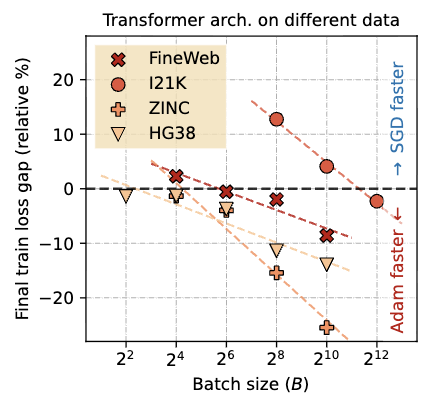
Prior work attributes Adam's advantage over SGD to various isolated factors. Rather than pinning the gap on a single cause [23], we show through controlled experiments that data modality, dataset, and model architecture all shape it in non-trivial ways. We further identify a consistent trend: a crossover batch size beyond which the relative advantage shifts from SGD to Adam, captured by a simple theoretical model of the gap.
Research Impact
These results improve training efficiency by reducing the need for costly hyperparameter sweeps and tuning, while increasing robustness. BST scaling and NGN step sizes lower computational overhead and sensitivity to learning rates, and SDE insights explain the strong empirical performance of adaptive methods under realistic, heavy-tailed noise.
Selected Publications
40th Annual Conference on Neural Information Processing Systems (NeurIPS 2026)
PDF
arXiv
NeurIPS
Abstract
43rd International Conference on Machine Learning (ICML 2026)
PDF
arXiv
ICML
Poster
Abstract
Enhancing Optimizer Stability: Momentum Adaptation of The NGN Step-size.
39th Annual Conference on Neural Information Processing Systems (NeurIPS 2025)
PDF
arXiv
NeurIPS
Poster
Abstract
13th International Conference on Learning Representations (ICLR 2025)
PDF
arXiv
ICLR
Poster
Abstract